

12 Ways To Make Money As A Content Creator (Playbook)


Everyone thinks that creators only make money from ads and sponsorships.
And though these are ways to turn an audience into a business, there's so much more to it.
Some creators make more money selling a $50 template than they ever made from a brand deal.
Others turn their audience into consulting clients, paying subscribers, product buyers, or even the first customers of a business they build.
And here's the surprising bit:
You don't need millions of followers to do any of this.
You just need an audience that trusts you.
There are a million ways to make money from an audience, but we have simplified the process by breaking it down into four levels.
We call this our Creator Monetization Playbook.
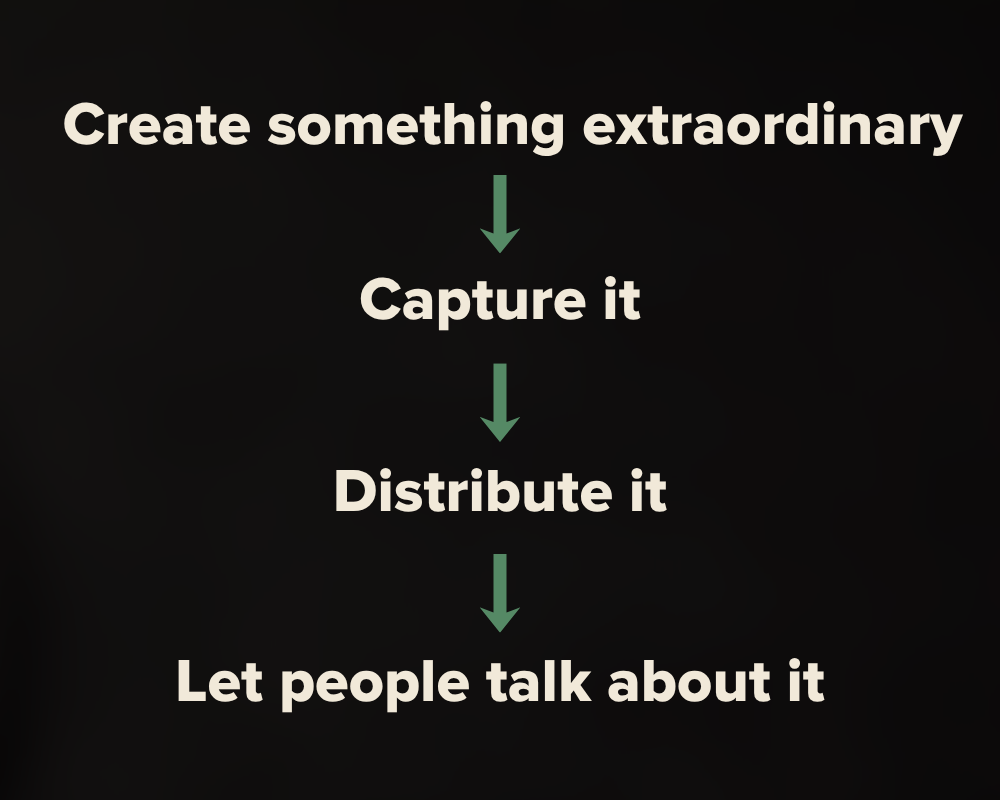
The key is knowing where you are, what you can sell, and when to move up.
Let's break down each level.
How to Make Money as a Content Creator?
We have listed and explained 12 proven ways of making money as a content creator.
Monetize Attention
The first level is pretty straightforward: you already have attention. So, you use that attention to get paid.
At this point, you aren't selling your own product or service.
What you are doing is monetizing the audience you've built by basically lending platforms, brands, or businesses access to their attention.
There are three ways to do this:
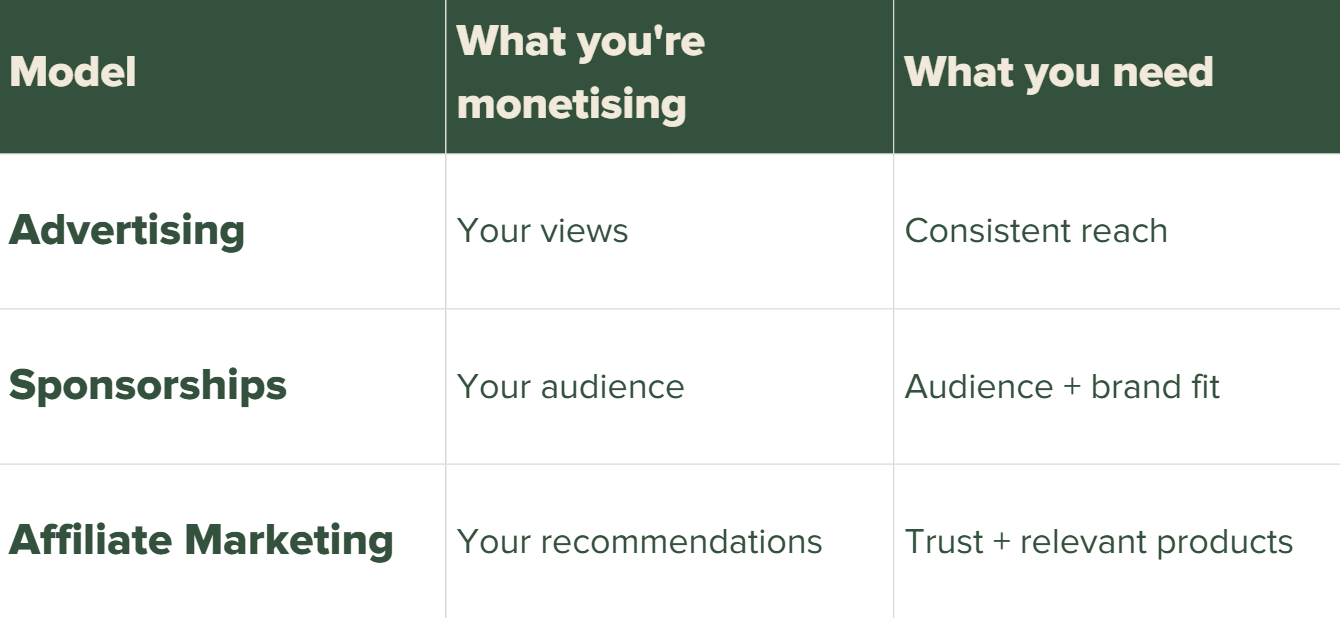
1. Advertising Revenue
This is something we're sure most of us are aware of. But we will cover it just in case.
Advertising revenue is revenue made by running ads on your content.
You create the content, whatever platform you are publishing on serves the ads, and you receive a share of the resulting revenue.
How do you start?
Before anything, you need three things:
- A platform - one that offers creators ad revenue
- An audience - which needs to be large enough to meet the platform's monetization requirements
- Acceptable content - which needs to follow the platform's monetization policies
The clearest example of this would be YouTube.
They currently require creators to have 1000 subscribers and either 4000 valid public watch hours in the past 12 months or 10 million valid public Shorts views within 90 days to meet the eligibility criteria for their YouTube Partner Program.
Pick a platform that matches the vibe of your content, work on it consistently, and focus on getting people to actually watch rather than simply chasing followers.
Once you meet the requirements, you can apply for the monetization program and, if approved, start earning from your content.
But there's a catch: Advertising is usually a game of volume.
As a creator, you will need a steady stream of views to generate a meaningful income.
Also, the amount you earn can vary significantly depending on your audience, content, geography, advertiser demand, and the platform where you publish.
This shouldn't be used as a primary source of income, but rather as a bonus reward for the attention you've earned.
2. Brand Sponsorships
These work slightly differently from ad revenue.
Rather than a platform paying you to rent your audience's attention, a company pays you directly to put its product in front of your audience.
The payment could also be in the form of free products in exchange for your content (no monetary payment involved). This is called Barter.
That could mean creating a sponsored Instagram post or reel, integrating a short product segment into your YouTube video, placing an ad somewhere in your newsletter, or even mentioning the product once or twice on your podcast.
For brand sponsorships, having a huge follower count isn't that important.
What do I mean?
Here is an example.
A creator with 30,000 followers, all of whom are interested in running, may be far more valuable to a brand that manufactures running shoes than a creator with 500,000 followers who covers completely unrelated topics.
Having a smaller, more relevant audience is more valuable to a brand than a larger irrelevant audience.
How to start?
Before approaching brands, make sure that you have:
- A clear niche - so that brands know exactly who likes your content
- An engaged audience - a huge follower count is useless if they don't engage
- Consistent content - brands need to know that you can create content reliably
- Evidence - demographics, engagement, and other audience stats that can prove that your audience matches the brand's ideal customer
Then, start approaching brands that make sense for your audience.
Then create a simple pitch explaining who you reach, why your audience fits the brand, what you can create, and what you're asking for.
You don't have to complicate things. A short, personalized email or DM is more than enough to start a conversation.
And at least initially, don't wait for brands to come to you.
Find smaller brands that you think your audience would genuinely benefit from and reach out to them. Your first sponsorship won't be with Nike or Apple, that's fine.
Once you've worked with a few brands, use those results as proof in your next pitch (use engagement, clicks, conversions, or even the quality of the content you produced). Build a track record in this fashion.
And when money, free products, discounts, or other benefits are involved, you also need to appropriately disclose the relationship between you and the sponsor.
The FTC(Federal Trade Commission), for example, says material connections should be clearly and conspicuously disclosed rather than hidden away in a profile or buried after the content.
One last thing: don't accept every sponsorship just because someone is willing to pay you.
If you promote something completely irrelevant to your audience, or if the products or services that you are promoting aren't up to their standards, they'll obviously notice.
That reduces your credibility and, in turn, makes you much less valuable to any brand you could work with in the future.
Your goal should be to make sure your sponsorships don't feel like advertisements but rather like recommendations from someone your audience already trusts.
3. Affiliate Marketing
This is the simplest model of the three for sure.
You recommend someone else's product, give your audience a link or code, and receive a commission when someone makes a purchase using your link or code.
Similar to sponsorships, this is especially useful if you are a small creator, because you don't necessarily need a huge audience but rather relevance and trust in your recommendations.
How to start?
Before anything, you need three things:
- Relevant affiliate products - like sponsorships, the product needs to make sense to your audience, and potentially even solve a problem they already have.
- Content with buying intent - content like reviews, comparisons, and tutorials can naturally lead people towards a purchase.
- A way to track and earn - you need to join an affiliate program to get a unique link or code that pays you a commission on sales.
You can start by looking at the things your audience is already asking you about.
What tools do they want to learn about? What products are they considering? What are the problems they are trying to solve?
Find products that answer these questions.
Then, rather than randomly dropping an affiliate link, show people how you use the product, why you like it, or whether it's actually worth buying.
And again, just like sponsorships, don't hide the fact that you earn a commission.
Affiliate relationships should be clearly disclosed near the recommendation.
Simply writing "affiliate link" may not be enough for consumers to understand that you are getting paid.
Also, don't promote everything and anything just because it earns you a high commission.
A product that earns you $50 isn't worth anything if nobody trusts you enough to buy it.
Remember, your audience's trust is an asset. Don't trade it for a quick commission.
Monetize Expertise
In the Monetize Attention section, you're getting paid because you have an audience.
At Monetize Expertise, you're getting paid because you can do something that can be valuable to others.
Here, you can start turning the skills, knowledge, and experience you've built into paid offers.
A massive audience is secondary.
You can get started as long as you have something people are willing to pay you to do or teach.
There are three methods to monetize your expertise.
You can decide which one to use based on what people are asking you.
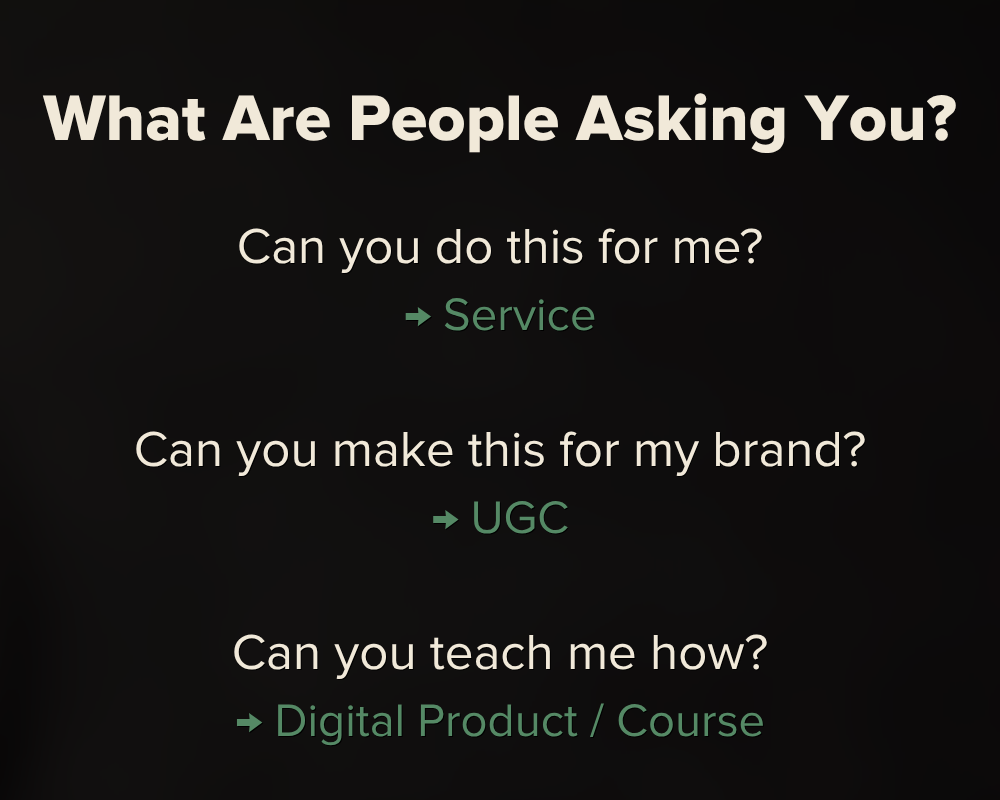
4. Selling Services
Instead of simply recommending something or putting an ad in front of your audience, you offer to solve their problem.
For example, a fitness trainer could offer personal training, a designer could offer branding or graphic design, and a marketing creator could offer content strategy, consulting, or social media management.
As long as there is a skill that people are willing to pay you for, the possibilities are pretty much endless.
How to start?
You need the four things given below:
- A valuable skill - something that can genuinely help people
- A clear offer - people should know exactly what they're paying for
- Proof of your ability - previous work, results, or even your own content can be used as your portfolio
- A way to find clients - your audience is one option, but you can also try cold outreach, referrals, or freelance platforms
Take whatever you do well and package it into an offer.
For example, if you are into content marketing, rather than saying:
"I offer content marketing services."
say:
"I'll create a 30-day content strategy for your business."
The more specific the problem you're solving, the easier it becomes for someone to understand exactly why they should pay you.
Don't wait until you have a huge following.
Your first client may come from your audience, or it might be someone you reach out to yourself.
Most importantly, you need to start building evidence of your capabilities.
Having a few successful projects under your belt can help you raise your prices, narrow your offering, and start attracting better clients.
Services can be one of the fastest ways to turn a skill into your first meaningful creator income.
5. UGC for Brands
UGC stands for user-generated content.
Let me draw a comparison between UGC and sponsorships for you:
With a sponsorship, a brand pays you because they value your audience's attention.
With UGC, the brand pays you to create content they can use.
In most UGC arrangements, you don't even need to post the content on your own account.
All you have to do is create something along the lines of a product demonstration, tutorial, unboxing, or a short-form video that the brand can use for its own social media or in paid ads.
How to start?
You need the following three things to begin:
- Ability to create good content - especially the short-form content that brands are looking for.
- Proof of work - brands need to see examples of what you can create before hiring you.
- Understanding of what brands want - you need to create content that sells the product, not just something that looks cool.
Again, don't wait for brands to reach out to you.
Pick a few products that you already own and create some sample UGC for them. Consider this as a way to build your portfolio before you have clients.
Then reach out to brands yourself. Brands that already work with creators or could benefit from the type of content you make.
And remember this: UGC is content creation as a service.
You're not being paid because you have a huge following, but because you can create content that sells.
That makes UGC an interesting option for creators with strong content-creation skills but who haven't yet built a huge audience.
6. Digital Products & Courses
This is the most scalable of the three.
Instead of selling your time as a service, you package your knowledge into something that you create once and can then sell over and over again.
The package could be anything from a template to an ebook, guide, toolkit, spreadsheet, or even a full-blown course. All it needs to do is help someone solve a problem.
For example, a finance creator could sell something like a budgeting spreadsheet, a designer could sell a collection of templates, and a marketing creator could turn their knowledge into a course or a playbook.
How to start?
To start selling digital products or courses, you need:
- Valuable knowledge - ideally something you've already proven you can help people with.
- A specific problem - don't teach people how to "market". Teach them how to build their first content strategy.
- A product people can use - don't package information for the sake of packaging information
- A way to sell and deliver it - platforms like Gumroad, Lemon Squeezy, Teachable, or even your own website can do this
Please don't spend six months building a 50-hour course that nobody needs.
Look at what your audience already needs help with. Their recurring questions will often become your best product ideas.
Pay attention when people keep asking, "How do you do that?"
That's a signal you shouldn't let go unnoticed.
Turn the answer to that question into something structured and useful, and then charge for it.
But there's a catch, and it's an important one:
Your digital product won't automatically become valuable just because you know a lot.
It's only valuable if it genuinely helps someone achieve a result faster, more easily, or better.
Selling information is not enough, anyone can do that. Start selling solutions.
Monetize Access
In the Monetize Expertise section, you're getting paid because you can do something valuable or because you teach something valuable.
You can take that a step further at Monetize Access.
Rather than simply selling your expertise, you start charging people for deeper access to it and to you.
This could mean a lot of things, including giving access to your thoughts through a paid newsletter, exclusive content through a membership plan, or a community of like-minded people behind a paywall.
These models are, in most cases, recurring.
Instead of making one sale and moving on, you give people a reason to keep paying you every month or every year on a subscription basis.
There are three ways to do this:
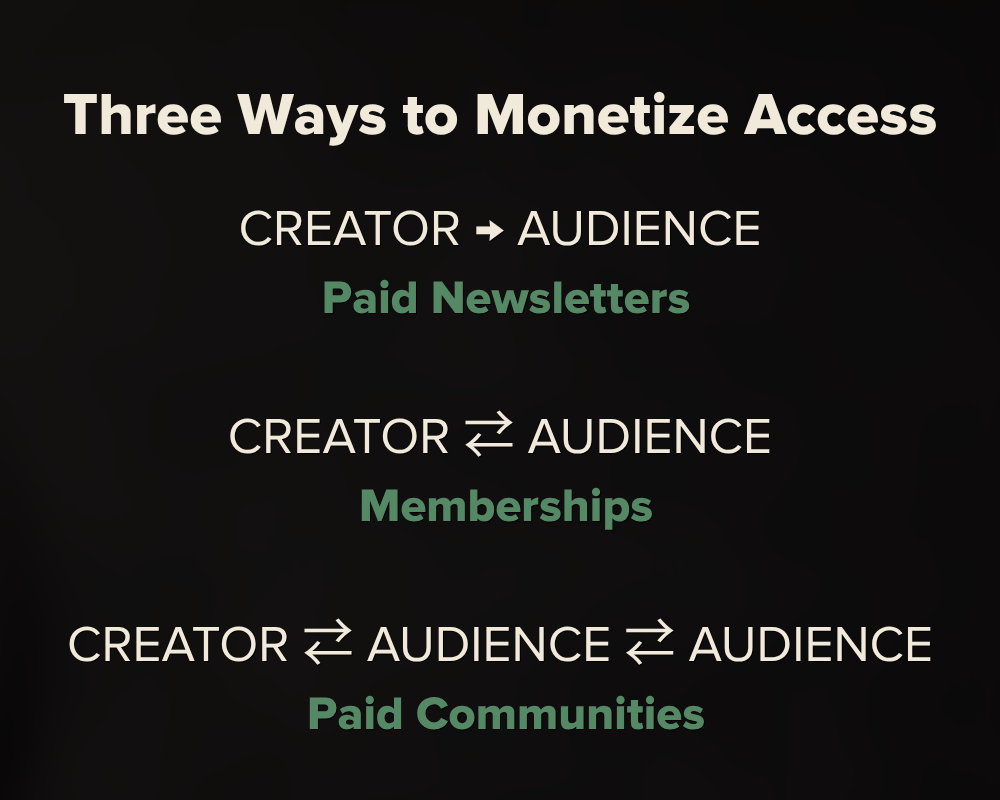
7. Paid Newsletters
A paid newsletter is exactly what it sounds like: people pay you regularly to receive content from you.
You could have a free version of your newsletter that gives readers access to your general thoughts, insights, or content.
The paid version could give access to something way deeper, like exclusive research, analysis, tutorials, BTS content, or anything else people find valuable enough to pay for.
The most important part here is that the content itself is your product.
People aren't paying just because they like you. No. They are paying you because you are giving them something extra, something that they wouldn't be getting from your free content.
How to start?
You need three things:
- Valuable content - something people genuinely want to read on a regular basis
- A clear reason to pay - your paid content needs to offer more than what you're already giving away for free to actually be credible
- A consistent publishing schedule - if people are paying every month, you need to ensure that your content always reaches them on time
Before launching a paid newsletter, test the waters with a free one first.
Use it to figure out which topics your audience actually cares about and, therefore, to get the most engagement. Then take the content people already value and go deeper. (not just longer)
Also, please don't make the mistake of putting every single useful thing you know behind a paywall. What you need to understand is that the content that reels people in is the free stuff.
One more thing: recurring revenue means recurring expectations.
If someone is paying you $10 every month, you need to give them $10 worth of content every month.
8. Memberships
Memberships and newsletters are quite similar, but what people are paying for is much broader than just your content.
Along with a combination of exclusive content, a membership plan gives you access to events, discounts, live sessions, coaching, or, if you are up for it, even direct access to you.
Think of it as a package of ongoing benefits that people keep paying to access.
For example, if you are a fitness creator, you could offer members personalized workout plans, monthly Q&As, or personal training.
If you create content in business, you could offer live sessions, templates, or mentorship.
And if you happen to be a designer, you could give members access to tutorials, workshops, or even offer to review their portfolios.
How to start?
You need the following first:
- A clear benefit - people should immediately understand its worth paying for membership
- Benefits worth coming back for - something that continues to provide value month after month
- A system for consistent delivery - you need to be able to actually maintain everything you're promising
Don't fall into the trap of adding 20 different perks just to make your membership look more valuable.
If you can offer three genuinely useful benefits, that's definitely better than twenty different things you barely have time to deliver.
You would have noticed the prerequisites are very similar to what's required for newsletters; that's because they are actually pretty similar.
What's the distinction then?
It's the level of interactivity.
A paid newsletter is mainly limited to content, whereas a membership can be much more personal.
As the interaction becomes more valuable, so does the reason for someone to keep paying you for the same.
9. Paid Communities
Paid communities take the idea of monetizing access one step further.
Now, rather than charging people for your content or your time, you're charging them so they can gain access to a group of people they want to interact with.
This group could include other creators, entrepreneurs, marketers, designers, or anyone working towards a similar goal.
The value of your community doesn't come from the amount or the kind of content you produce. It comes from the people who are a part of it.
A YouTube content creator could build a community for aspiring YouTubers, for example, where members share feedback, opportunities, and advice.
A marketing creator could build one where members discuss campaigns, exchange ideas, and help solve each other's problems.
How to start?
You need three things:
- A specific group of people - "entrepreneurs" is probably too broad, "early-stage founders building their first SaaS" is much more specific, and that's the kind of community you need to build
- A reason for them to interact - networking, accountability, feedback, education, opportunities, or something else
- Active community management - a Discord server with 500 members isn't a community if nobody talks in it
A good community will almost always create value between its members.
That's what makes it different from a newsletter or a membership. You're no longer the only source of value.
As the community grows and members start helping, connecting, and sharing, value can extend beyond what you personally provide.
Your audience slowly becomes a part of your product...
Starting a Business
In the Monetize Access section, you're getting paid for deeper access to you, your content, or your audience.
In this section, you take it one step further, yet again.
You've built an audience.
Now, you make use of them to create a business of your own.
That could mean selling physical products, launching a company to solve a problem your audience faces, or turning your ideas, content, and brand into intellectual property that other businesses will be willing to pay for.
As a creator, you have something most new businesses spend years trying to build: distribution.
The fact that you already have people who know you, trust your recommendations, and are interested in what you have to say, that, is your competitive advantage.
You can start a business in the following three ways:
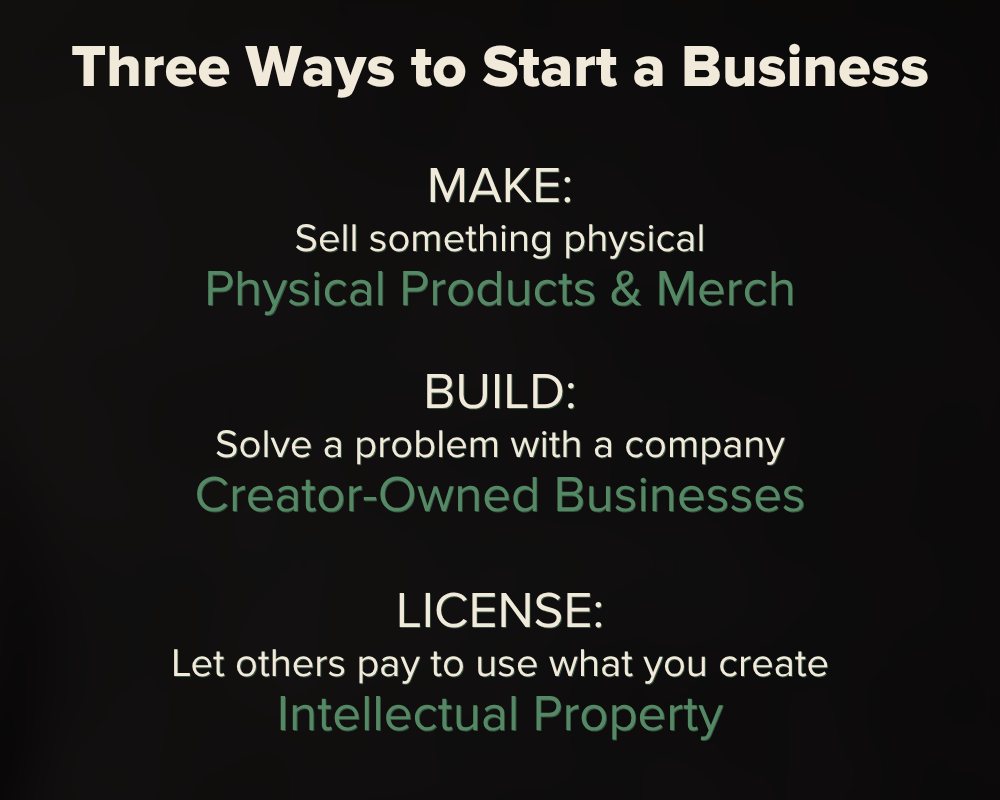
10. Physical Products & Merch
This is definitely one of the most popular and obvious ways for bigger creators to earn.
You create something physical your audience might want to buy and then sell it.
That could range from merchandise like branded clothing and accessories to something like workout equipment for a fitness creator or kitchen products for a culinary influencer.
Make sure you create a product because your audience wants it, not just because you have an audience.
How to start?
You need:
- A product people actually want - ideally something connected to a problem or interest your audience already has
- A way to produce and fulfill it - whether that's manufacturing it yourself, working with a supplier, or using a service like print-on-demand
- Enough demand to make the economics work - you need to account for production, shipping, returns, marketing, and platform fees before deciding what you can actually afford to make
Start small. Don't make the mistake of ordering 10,000 units of a product before even knowing whether anyone wants it.
Test the waters first.
Ask your audience if the product is something they would actually buy, run a pre-order, or launch a small batch.
Never assume that your audience will automatically buy something just because they follow you.
The product still needs to solve a problem, satisfy a need, or give people a reason to want it.
11. Creator-Owned Businesses
This is where things start getting really interesting.
Instead of simply selling products to your audience, you build a business around a problem they face.
You can see the questions they ask, the problems they complain about, the products they wish existed, and the things they are already willing to spend money on.
For example: A fitness creator could build a fitness app, a productivity creator could build a productivity tool, a marketing creator could launch a research platform, an agency, a software product, or an education business.
The possibilities are pretty much endless.
How to start?
You need:
- A real problem - something your audience genuinely struggles with and would be willing to pay to solve
- Evidence of demand - recurring questions, audience feedback, waitlists, or people willing to pay are good signals
- A business model - you need to know how the business will actually make money
- A way to execute - whether you build it yourself, hire people, or bring in partners, someone needs to actually build and run the business
And this is where having an audience gives you a pretty big advantage.
You don't have to build something and then spend months trying to find your first customers. You already have potential customers watching you.
Test the idea with them first.
Ask what they would actually pay for. Build a simple version, get feedback, and if possible, get people to pay before you spend a fortune building the final product.
But don't make the mistake of assuming that having an audience means you have a business.
An audience can give you distribution, but it doesn't give you product-market fit, a good business model, or a great product.
You still need to build something people actually want.
All your audience does is give you a head start.
12. Licensing & Intellectual Property
This is probably the least obvious way to monetize an audience.
Instead of selling your content directly, you can turn the things you've created into assets that other businesses are willing to pay to use.
That could include your name, brand, characters, designs, photography, videos, educational frameworks, formats, or any other intellectual property.
For example, a creator with a recognizable character could license it to a clothing company, a photographer could license their images to brands, a creator who develops a popular educational framework could turn it into books, training programs, or other products.
The biggest advantage to this is that you aren't selling your time. You're allowing someone else to use something you've already created.
How to start?
You need:
- Something worth licensing - a recognizable brand, original content, design, character, framework, or other intellectual property
- Ownership or the rights to use it - you can't license something that you don't have the legal rights to
- A potential commercial use - there needs to be a reason another business would want to use it
- A way to structure the deal - licensing agreements need to clearly define things like where, how, and for how long your IP can be used
You don't necessarily need to create something specifically for licensing.
Sometimes, the most valuable IP is something that naturally comes out of your content.
A recurring character, a catchphrase, or a framework becomes something people associate with you.
The key is recognizing when something you've created has value beyond the piece of content it originally appeared in.
You could create something once, build an audience around it, and then allow other businesses to pay you for the right to use it.
Do that, and you're officially an IP owner!
Conclusion
You don't need to use all 12 of these monetization methods.
In fact, you probably shouldn't. Start with whatever makes the most sense for where you are right now, and move up as your audience, skills, and opportunities grow.
If you have attention, monetize it. If you have a valuable skill, sell it. If people want deeper access to you, give them a reason to pay for it.
And once you've built enough trust and understand what your audience actually needs, you can start building something of your own.
The goal isn't to squeeze money out of your audience in every possible way.
It's to turn the trust you've built into something that creates value for both you and your audience.
And that's our creator monetization playbook!