

How To Get Sponsors For Your Newsletter (Complete Guide)


Gaining more subscribers doesn't really matter at first.
What matters more is that you should have a clear, niche-based audience, and evidence of engagement with your content.
This is what makes your newsletter valuable to sponsors.
But I'm not saying you don't need subscribers at all.
At least with 5,000-10,000 subscribers, you should focus more on content quality and distribution to attract the right audience.
Well, we know this from running our DevOpsCube Newsletter, where we publish content related to DevOps, MLOps, and Kubernetes for more than 21,000+ readers.
In this guide, I will explain how to get sponsorship, how to create a media kit, and what metrics sponsors usually look for.
Before getting into it in depth, let's look at what matters for a sponsor.
Subscriber Count & Audience Fit
To be honest, there is no specific number of subscribers you need before you can get a sponsorship.
I would say, having a niche-based newsletter with 5,000 subscribers is better than having 30,000 random or broad subscribers.
If you have a niche newsletter, you are more likely to have an audience of professionals interested in that specific topic.
For example,
If you have a marketing newsletter, your audience would be marketing professionals.
That means products and services related to marketing are more likely to be interested in sponsoring your newsletter compared to a general newsletter.
This is one of the biggest lessons we apply to our DevOpsCube newsletter.
Well, our newsletter is not positioned simply as a 'technology newsletter'.
We focus mainly on DevOps and MLOps-related content.
This makes it easier to identify the types of products or services that could benefit from reaching our audience.
Before approaching sponsors, I would recommend that you have at least:
- A clear niche
- A consistent publishing schedule for newsletters
- Recent email performance metrics
- A clear description of your audience
- A pricing method
- A way for advertisers to contact you
Next, let's look at the newsletter metrics you should provide to sponsors.
Newsletter Metrics Sponsors Care About
Before agreeing to sponsor your newsletter, sponsors will usually look at several metrics. These may include:
- Open rate
- Click-through rate (CTR)
- Active subscribers
- Sponsor link clicks
- Sometimes they will ask about audience location
According to MailerLite's latest benchmark report, which analyzed 3.6 million campaigns from 181,000 approved accounts.
- Open rate: Around 35-40% is good, above 40% is literally very healthy.
- CTR: Around 1% or above is good, and above 2% is strong
These are some of the metrics sponsors may ask for, so you should provide recent and accurate data.
Set Up Sponsorship Opportunities
Once you have finalized your niche and understand who your audience is, the next step is to create a sponsorship page, and media kit.
These will help sponsors quickly understand your newsletter and advertising opportunities.
Build a Newsletter Media Kit
I don't recommend creating a 20-page PDF media kit.
In fact, I prefer something simple, and that would quickly answer an advertiser's question of whether your newsletter is relevant to their campaign.
A newsletter media kit should generally include newsletter name, URL, audience information, subscriber count, delivered audience, open rate, click performance, sponsorship formats, pricing, and contact information.
If you want to see our newsletter media kit, I have attached it below.
Create an Advertise With Us Page
One of the best things you can do is create a dedicated page for advertisers.
At DevOpsCube, we use a dedicated newsletter sponsorship page.
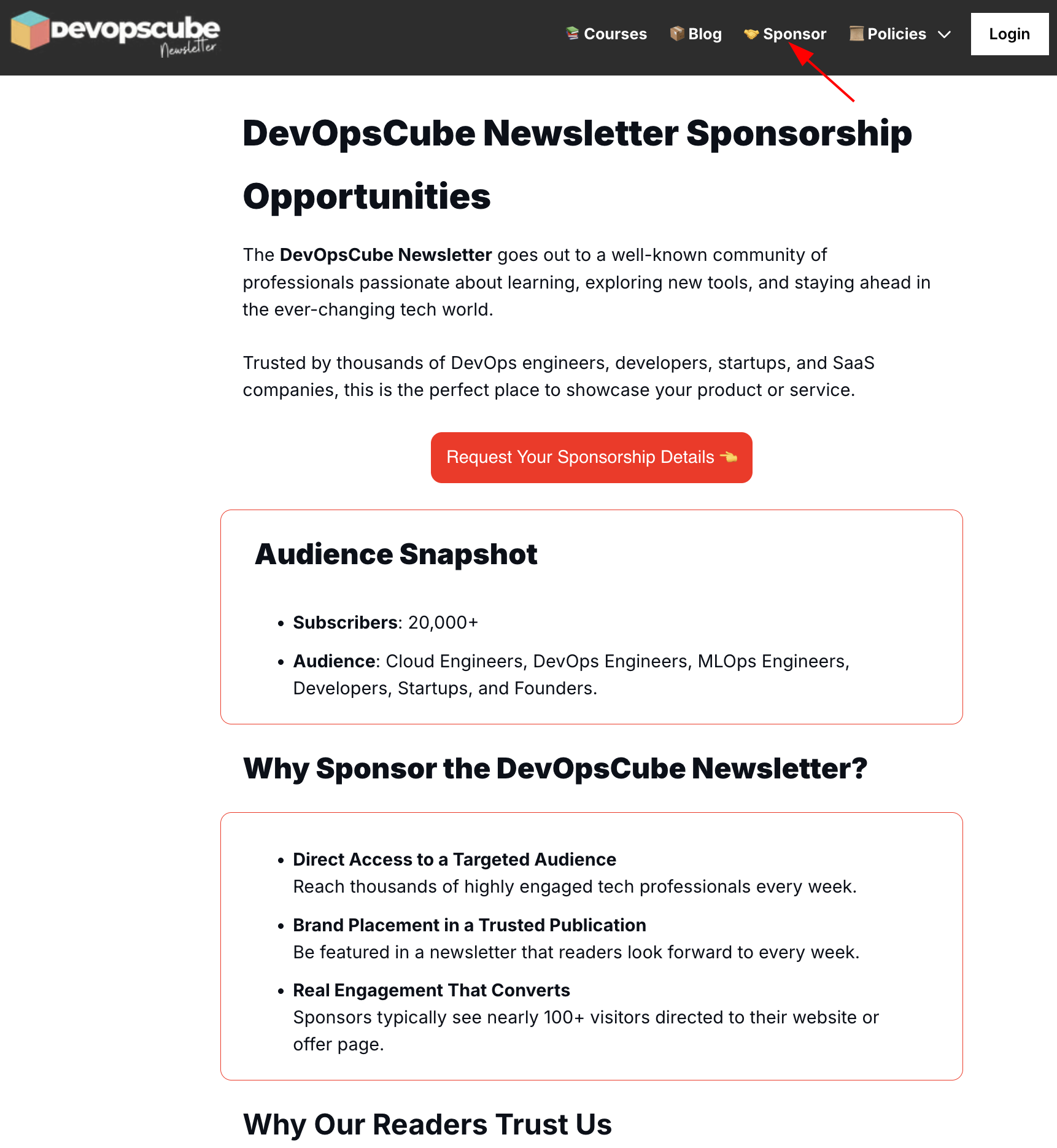
This makes it much easier for sponsors to contact you instead of searching for your email address or any other way to reach you.
On our advertising page, we keep the information simple and to the point and provide a media kit for advertisers who want to learn more about the newsletter
Another one way is that you can show everything on your advertising page, such as,
- Your audience
- How large is your audience
- What kind of topics you will cover
- Sponsorship options
- Sponsor placement options
- Sponsorship cost
- Slot availability, and more
This removes uncertainty and makes the sponsorship process clearer.
A good example is Dense Discovery's advertising page.
Types of Newsletter Sponsorship Options
I wouldn't recommend creating ten different sponsorship formats when you're starting.
One or two good placements are much easier to manage.
Here are the common formats:
- Classified - Short text advertisement with link
- Sponsored section - A separate promotional section inside a newsletter.
- Dedicated email - An entire email focused on one advertiser.
We usually try to keep sponsorship in a natural format so they fit alongside our regular educational content without turning the entire newsletter into an advertisement.
The most important thing is to clearly show advertisers what the sponsorship format looks like before selling it.
For example,
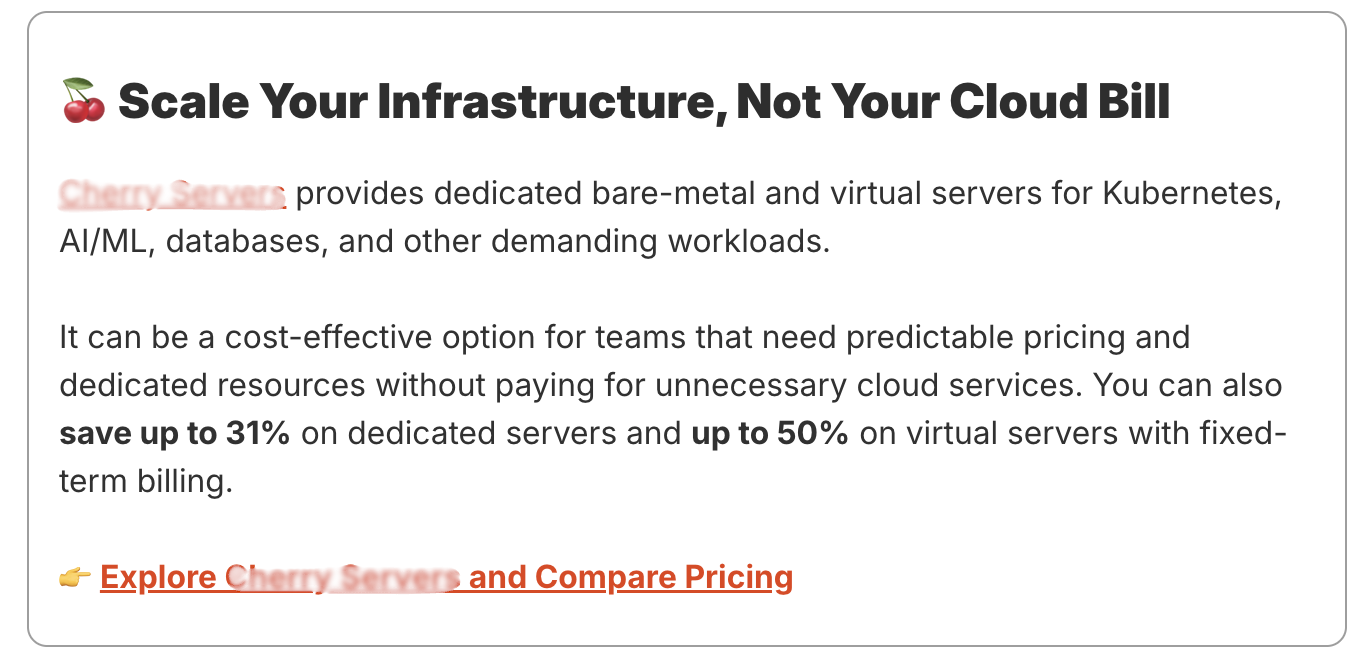
A sponsored section includes a maximum of 150 words, one image, and one link.
It may be placed after the newsletter introduction and clearly marked as sponsored.
Here is one of our sponsor section formats in DevOpsCube.
How to Find Sponsors for Your Newsletter?
I want to make one thing clear.
Just creating a sponsorship page or package will not automatically bring advertisers to you.
You still need to reach out to companies.
Here are some of the things I am doing right now.
Start with Companies Already Serving Your Audience
This is one of the easiest ways to start finding sponsors.
For example, if I want to find sponsors for SkaleCube, I would start with companies offering:
- AI content creation tools
- SEO tools
- Social media management platforms
- Email marketing platforms
- Marketing automation platforms
- Marketing courses
- AI image, audio, and video generation tools.
Obviously, I would reach out to these companies because SkaleCube focuses on the AI Digital Marketing niche.
You can follow the same approach for your newsletter.
Identify your niche first, then find companies that already sell products or services to your audience.
If you find it difficult to identify companies, you can use ChatGPT by providing your niche and asking it to generate a relevant list.
Check Similar Newsletters
Subscribe to newsletters in your niche.
There is a good chance that many established newsletters will include sponsored sections in their emails.
We do this with the DevOpsCube newsletter as well.
When you see a sponsor, note the sponsor's name and website in a document or whatever tool you use to track prospects.
This helps you identify companies that are already using newsletter advertising as part of their marketing strategy.
One more thing,
Even if you reach out to these companies, not every sponsor will reply or be interested in sponsoring your newsletter.
That's the hard reality of outreach
Match the Sponsor to the Newsletter Topic
This is something we are doing well with our DevOpsCube newsletter.
Let's say,
I'm preparing a SkaleCube newsletter edition about why building an email list matters.
So I could reach out to an email marketing platforms and say:
I'm preparing an upcoming newsletter edition about why building an email list matters. You product would be a good fit for the topic, so I thought this campaign might be relevant to you.
This shows that you actually looked at the product and thought about why it would be relevant to your readers.
That makes your pitch much stronger.
Tell your Existing Audience you Accept Sponsors
You may even find your sponsors from your existing audience.
Some of your readers may work for Saas companies, marketing teams, vendors, or other businesses that want to reach your audience.
So in the newsletter, you can naturally mention your advertising opportunities inside your newsletter.
For example,
Interested in reaching marketers directly? Sponsor an upcoming SkaleCube newsletter to showcase your product or services.
You can add content like this occasionally.
Sometimes, you may not even need to actively promote your sponsorship page.
If your newsletter is useful and reaches the right audience, companies may contact you directly.
Consider Sponsorship Marketplaces and Ad Networks
Direct sponsorship is not your only option.
You can also use newsletter sponsorship marketplaces, advertising networks, and agencies.
For example,
Platforms such as Paved and Passionfroot connect publishers with potential sponsors.
There are many other platforms available as well.
Beehiiv's Ad Network also provides built-in advertising opportunities for eligible publications and supports CPM(Cost Per Mille or Cost Per Thousand), and CPC(Cost Per Click) campaigns.
These platforms can help connect your newsletter with advertisers.
How to Pitch Newsletter Sponsors?
Don't send a long email filled with unnecessary information.
Your email mainly needs to answer three questions:
- Why is your audience relevant?
- Why are you contacting this company?
- What are you offering?
Don't send the same generic outreach email to every company.
Make your outreach specific and personalized.
Here is a simple outreach template you can use:
Subject: [Brand]: Sponsorship Opportunity in [Newsletter]

Hi, [Name]

I'm [Name] from [Your Newsletter Name], a newsletter for [specific audience]

I noticed [specific product, launch, article, or announcement]. It looks particularly relevant to our readers because [specific reason].

We currently reach [subscriber], and our newsletter focuses on [topics].

We have a slot for the upcoming newsletter edition about [topics].

You can see our newsletter and information here in our media kit attached to this email.

Would this campaign be relevant to what you're looking for?

If this sounds interesting, I'd be happy to discuss the available sponsorship opportunities or answer any questions.

Looking forward to hearing from you!

Newsletter: [Link]
Sponsorship Page: [Link]

Thanks,
[Name]
[Your Newsletter Name]
The more specifically you can connect the sponsor's product with a problem your readers have, the stronger your outreach becomes.
How Often Should You Follow Up?
You can follow up to three times.
Sometimes people will miss the email. Other times, they may see it but not consider it important enough to reply immediately.
A follow-up gives you another opportunity to get their attention.
If they are not interested, they may also give you a clear answer after receiving a follow-up.
I mention this because I sometimes reply to emails I initially ignored after receiving a useful follow-up.
Following up can also increase your chances of closing a sponsorship deal.
Label Sponsored Content
Don't make an advertisement look like independent editorial content.
The U.S. Federal Trade Commission's native advertising guidance explains that advertising should not misleadingly appear to be independent editorial content and that necessary disclosures should be clear and easy to notice
The main risks of not disclosing sponsorship include misleading your readers, losing audience trust, and creating regulatory issues.
Also, clearly label sponsored section as Advertisement or Sponsored Content.
Conclusion
In this guide, I shared the key things you need to know about getting sponsors for your newsletter, based on our experience building and monetizing the DevOpsCube newsletter.
First, focus on providing useful, high-quality content and building the right audience.
Then, once you have a clear niche, engagement data, and a consistent readership, start approaching relevant sponsors.
This is the approach we followed, and it has worked well for us.
Yeah, that's pretty much everything.
If you have any doubts about this topic, drop them in the comments.
I'll be happy to help:)
This guide might help you understand other ways to monetize your newsletter.