

How to Get Cited by AI (ChatGPT, Claude & Others)


Imagine spending weeks writing an article that’s genuinely useful, only for ChatGPT to answer the same question that your article covers and cite three of your competitors instead.
Your content exists, true. But your competitors get the visibility.
That's the problem marketers are starting to face as search changes.
In this blog, you will learn to get your website cited by AI search engines with practical tips to improve your content, credibility, and visibility in ChatGPT.
Let's look into it in detail.
Google's AI Overviews now reach over 2.5 billion monthly users, while AI Mode has surpassed 1 billion monthly users. These are Google's own figures, and they show just how quickly AI-powered search has become part of our search experience.
And here's the part that you need to pay attention to: getting mentioned by an AI tool isn't quite the same as getting your website cited as a source.
A citation gives users a direct link to the page behind the answer. That creates another opportunity for businesses to get discovered, even when someone doesn't start with a traditional list of search results.
This isn't just our speculation either.
A 2026 study by DeltaV Digital tracked 21,075 AI search responses and analyzed 25,337 citations across five AI search engines and eight different industries.
It was found that the types of pages being cited varied significantly by industry.
So, what makes an AI search engine cite one website instead of another?
And more importantly, what can you actually do to improve your chances of being that source?
How AI Search Engines Find and Cite Websites
So, how does an AI search engine decide which websites to cite?
Let's break it down into three stages:
- Discovery
- Selection
- Citation
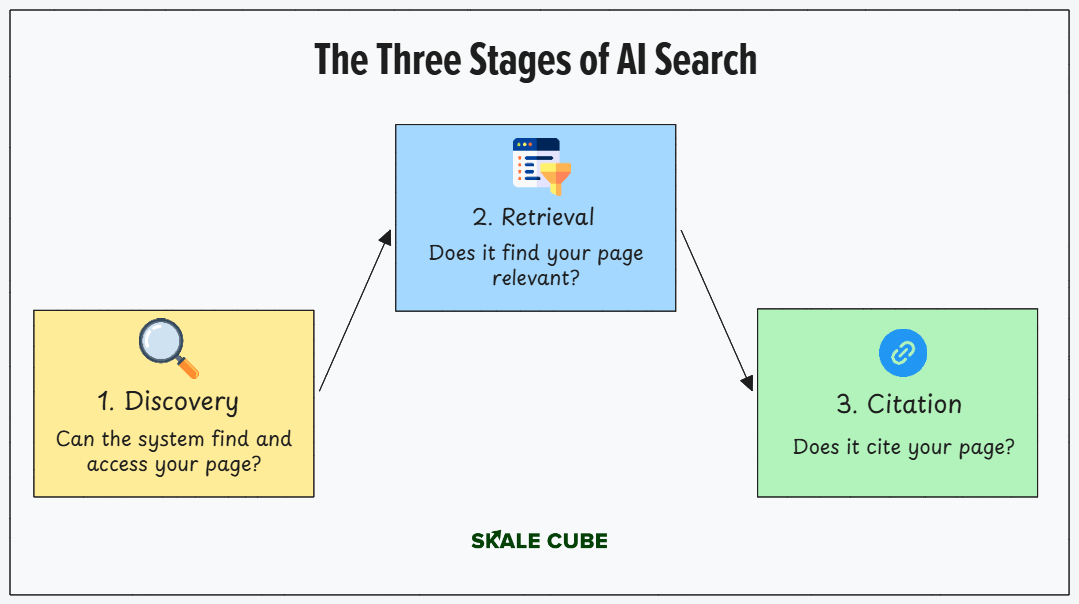
First, the system needs to find your page.
If your website blocks the relevant crawler or your page isn't accessible, you're at a disadvantage even before the process starts.
OpenAI recommends allowing OAI-SearchBot to crawl your website so its content can be discovered and included in ChatGPT search results.
Google has a similar requirement: pages must be indexed and eligible to appear with a snippet in Google Search to qualify for AI Overviews and AI Mode.
But as we mentioned earlier, getting discovered is only the first step.
The system still needs to retrieve information relevant to the question and decide which sources to cite. And these systems all work in different ways.
Google's AI search features, for example, can run multiple related searches across subtopics, while ChatGPT Search can rewrite a user's question into more targeted queries.
It found that whether an AI search engine retrieved a page in the first place mattered more for citation patterns than the page features researchers measured.
In other words, even a well-written article can't be cited if the system never brings it into the search results.
The takeaway?
Being accessible gets your website into the running. It doesn't guarantee a citation.
So, once your page is discoverable, what actually makes it worth citing?
What Types of Content Actually Get Cited?
What should you be writing to get cited by AI search engines?
Should you be writing listicles, detailed guides, product comparisons, or original research?
At the beginning of this blog, we looked at DeltaV Digital's research and found that AI citation patterns vary by industry.
But what does that actually look like when you examine the types of pages being cited?
In B2B technology services, listicles accounted for 61% of citations. For one local services brand, homepages accounted for 55%. In higher education, program pages made up 53%.
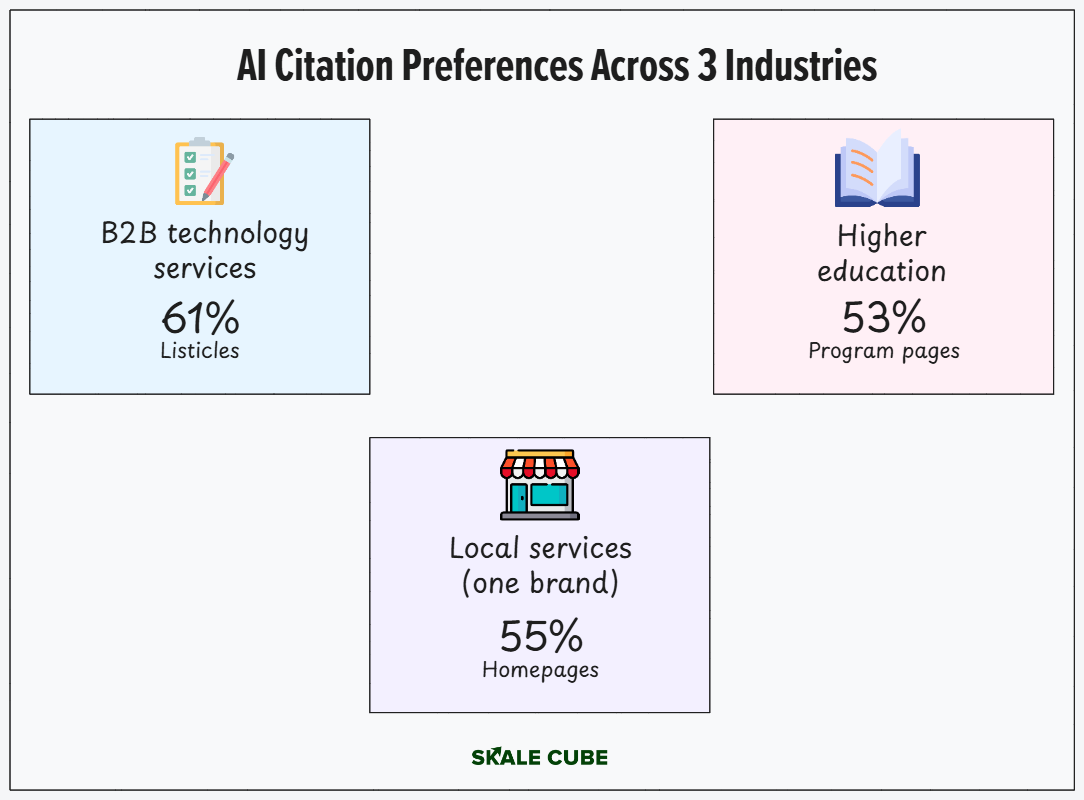
The AI search engines are the same. But the types of pages getting cited are completely different.
Across the full study, articles accounted for 23.7% of citations, followed by listicles at 19.6% and product pages at 16.3%.
No single format dominated across every industry.
So, should you start publishing listicles tomorrow? Not necessarily.
The format does matter, but so does whatever it is that the page actually offers.
Original research gives AI data to reference, detailed tutorials answer specific questions that readers might have, product comparisons help people evaluate alternatives, and expert commentary adds context that a generic explanation might miss.
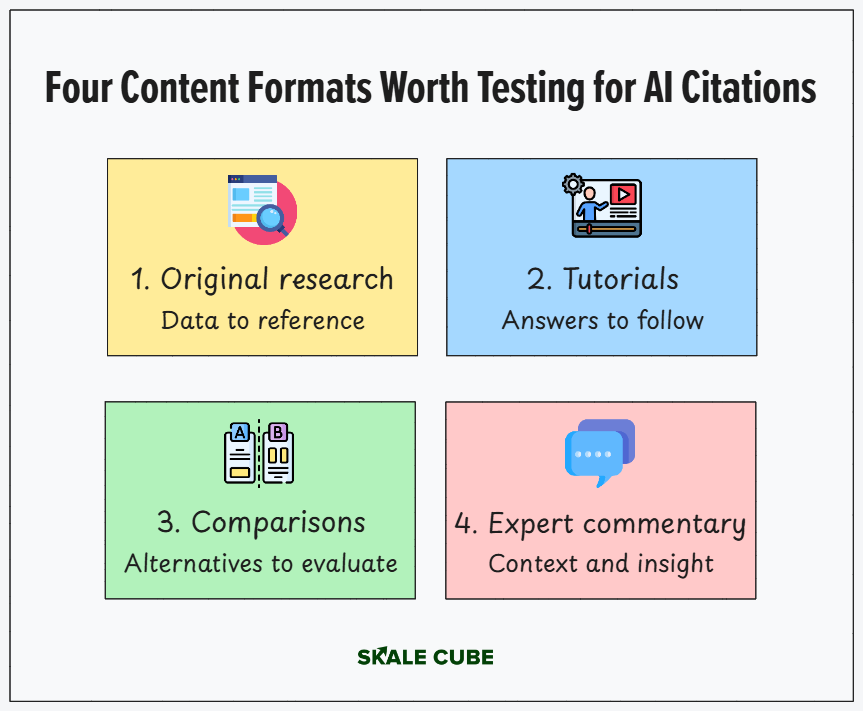
These are not guaranteed strategies to get cited, just useful formats that might be worth testing. The study just tracked citation patterns that currently exist.
It didn’t prove that changing the page to a certain format will automatically earn more citations.
And that’s the bigger point: don’t copy a content strategy just because it worked for another industry.
We wanted to go beyond other people’s findings.
So, we decided to test something ourselves: what does ChatGPT actually cite when you ask it real questions?
What We Found When We Tested ChatGPT and Claude
Other people's studies are useful. But we wanted to see for ourselves.
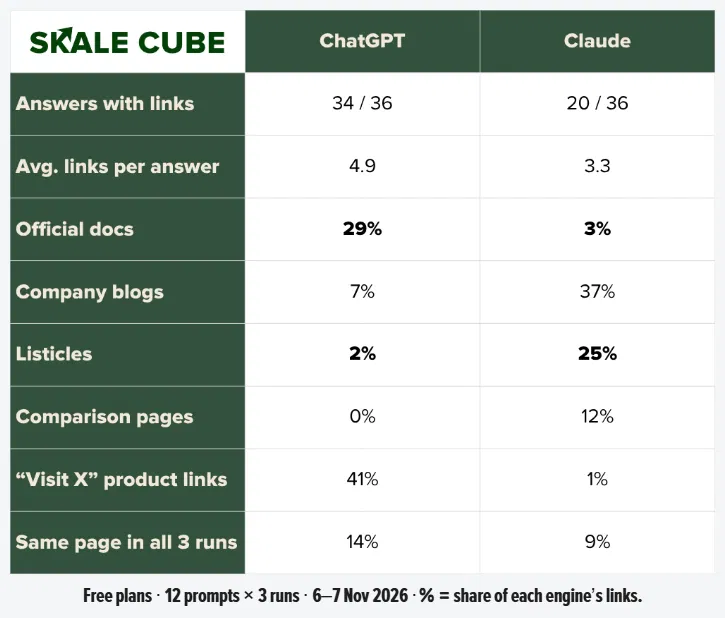
So we asked ChatGPT and Claude the same 12 questions, three times each. That gave us 72 answers and 295 links.
The short version? The two engines barely agree. Claude often doesn't search at all. And asking the same question twice usually brings back different sources.
How we ran the test
- 12 prompts, 4 types: how-to, comparison, definition, and best-of. All were about AI search and content marketing.
- Two engines: free ChatGPT and free Claude. Web search was on. Memory was off.
- A fresh chat every time: no follow-ups, so no answer could shape the next one.
- Three runs per prompt: to see if the citations stay the same.
- When and where: 6th and 7th November 2026, from India.
- What we logged: every link in every answer, its position, the type of page, and who published it.
The results at a glance
Percentages are shares of each engine's links: 177 for ChatGPT, 118 for Claude.
Finding 1: Claude often didn't search at all
Web search was switched on for every Claude chat. Even so, 16 of its 36 answers came from memory, with no links.
For 5 of our 12 prompts, Claude never searched in any of the three runs. These were simple how-to and definition questions, like "What is generative engine optimization?"ChatGPT searched every time. Only 2 of its 36 answers had no links.
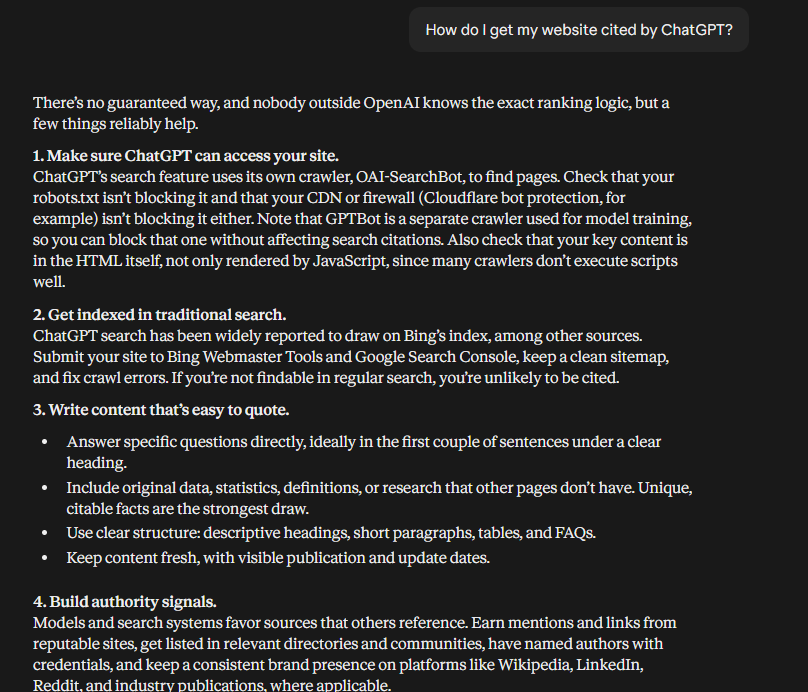
What it means: you can't be cited if the AI doesn't look anything up. For basic questions an engine feels sure about, a citation may not be on the table.
Finding 2: Each engine trusts different kinds of pages
ChatGPT leaned on official documentation. Google Search Central, OpenAI's help pages and Bing's guidelines made up 29% of its links.
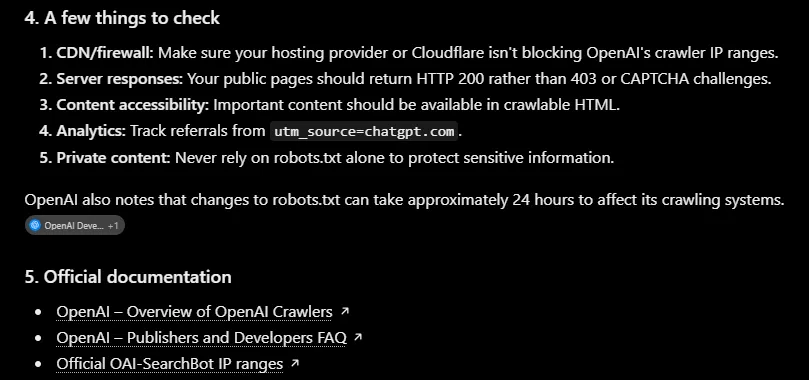
Claude went the other way. Most of its links pointed to company blogs (37%), listicles (25%) and "X vs Y" comparison pages (12%). Official docs were just 3%.
This also differs from the bigger studies we covered earlier. DeltaV Digital found listicles took 61% of citations in B2B tech. In our test, ChatGPT cited them barely at all. Our questions were about AI search itself, a topic with plenty of official docs, and that likely matters.
Finding 3: The two engines almost never agree
Only two pages were cited by both engines: OpenAI's crawler documentation and Google's guide to AI features.
Everything else was different. If you check only one engine, you see only half the picture.
Finding 4: Ask again, and you get different sources
We asked every question three times. Most cited pages showed up only once.
- ChatGPT: only 14% of the pages it cited for a prompt appeared in all three runs.
- Claude: only 9%, counting the prompts where it searched every time.
One ChatGPT prompt gave us 1 link, then 3, then none.
What it means: a single check tells you very little. Test the same question more than once before drawing conclusions.
Finding 5: Not every link is a citation
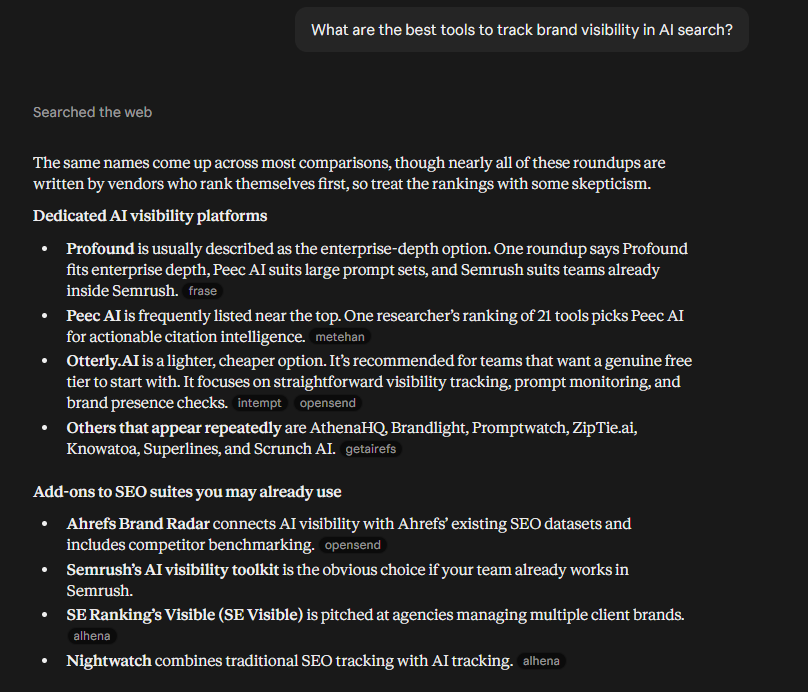
41% of ChatGPT's links weren't sources at all. They were "Visit Semrush"-style links to tools and homepages that ChatGPT recommended.
If you track AI citations, separate the two. Being recommended as a tool and being cited as a source are not the same thing.
What this test can't tell you
We want to be clear about the limits:
- It's small. 72 answers on one topic is a snapshot, not a study.
- It's one niche. All 12 questions were about AI search. Other topics may get very different sources.
- It's free plans only. Paid ChatGPT and Claude may search and cite differently.
- It's one moment. These tools change often. Run the same test next month, and you may see new patterns.
- Some labels are our judgment. We sorted each page into a type by hand. Every label is in the raw data, so you can check them.
- A few answers are partial. For 3 Claude answers, we could record which websites were cited, but not the exact pages.
The takeaway?
There is no single "AI search" to optimize for. ChatGPT and Claude look in different places, and neither gives the same answer twice.
So before you change anything, do these three things:
- Check both engines. Being cited by one tells you almost nothing about the other.
- Check more than once. Ask the same question at least three times.
- Check what kind of pages do well. Are they official documents, listicles, or comparisons? That tells you what each engine wants for your particular topic.
Tools like Semrush AI Visibility can track this at scale. But even a simple sheet like ours shows you where you stand.
So, once you know where you stand, how do you improve your chances?
How to Get Your Website Cited by AI Search Engines
So, how do you actually improve your chances of getting cited?
Based on the research we’ve covered, we’d start with four things.
1. Make sure AI search can find your website
First, check that search engines can access your pages and that you haven’t accidentally blocked them.
If you want your website to appear in ChatGPT search, OpenAI recommends allowing its OAI-SearchBot to crawl your site.
You can check this in your website’s robots.txt file, which tells crawlers which parts of your site they can access.
Just don’t confuse it with GPTBot, which OpenAI uses for crawling related to model training.
2. Give AI something worth citing
Try to publish original research, case studies, expert interviews, or at least your own analysis of existing data.
Google recommends that you create content that is helpful, reliable, and offers value to readers, not content made primarily to manipulate rankings.
Google’s helpful content guidance explains this in more detail.
3. Make it easy for AI to find the answer in your content
Don't make readers dig through five paragraphs to find the information they're looking for.
Get to the point, use headings that tell readers what's coming, and back up your claims with actual data and links to the original sources.
If you're sharing research, explain where the numbers came from and when the study was conducted.
The easier it is to find and check the information, the more useful your content becomes.
4. Build credibility beyond your website
Try to get your work referenced in relevant industry publications, expert discussions, and reputable websites.
These are worth pursuing, but don’t treat any one type of mention as a guaranteed way to earn AI citations.
At the end, make sure that you measure what happens.
Retest the same questions after updating your content, and track AI citations, brand mentions, referral visits, and conversions separately.
Google confirms that eligibility for its AI search features doesn’t guarantee your page will appear.
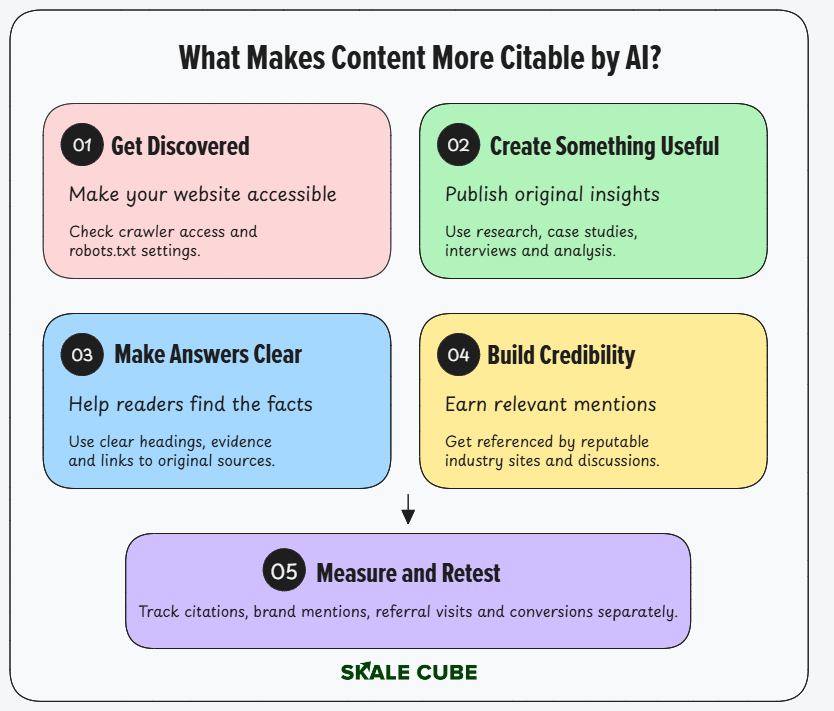
You can’t control which page an AI tool selects.
But what you can try and do is make your content easier to find, more useful to cite, and easier for readers to trust.
Conclusion
Getting your website cited by AI search engines doesn’t involve finding some secret SEO trick (there isn’t one).
It’s about making sure AI can access your content, giving it something useful to work with, and figuring out what actually gets cited.
First, try and get the basics right.
Make your website as accessible as possible, publish original research and insights that can’t be found elsewhere on the web, and make your claims easy to verify by providing credible sources.
Now, doing these things won’t guarantee you citations, but they give your content a better starting point.
And don’t assume that what works for another website will work for yours.
As we’ve seen throughout this article, citation patterns vary, and there’s no single content format that guarantees results.
So, here’s your challenge: pick five questions your target audience is likely to ask ChatGPT.
Check which websites it cites, see where your content is missing, and work on filling those gaps.
Don’t just hope AI search finds your content. Give it a reason to cite you, then measure your AI visibility.