

Coursera's Marketing Strategy and Growth in the AI Era


We did some research on Coursera's growth and how it is surviving in this AI era.
Let's look at what we found.
We started with a question:
Why would anyone pay to learn something from Coursera when ChatGPT can teach you almost anything for free?
AI should be killing Coursera.
At least, that's the theory.
Is that what happened?
Take a look at the numbers yourself:
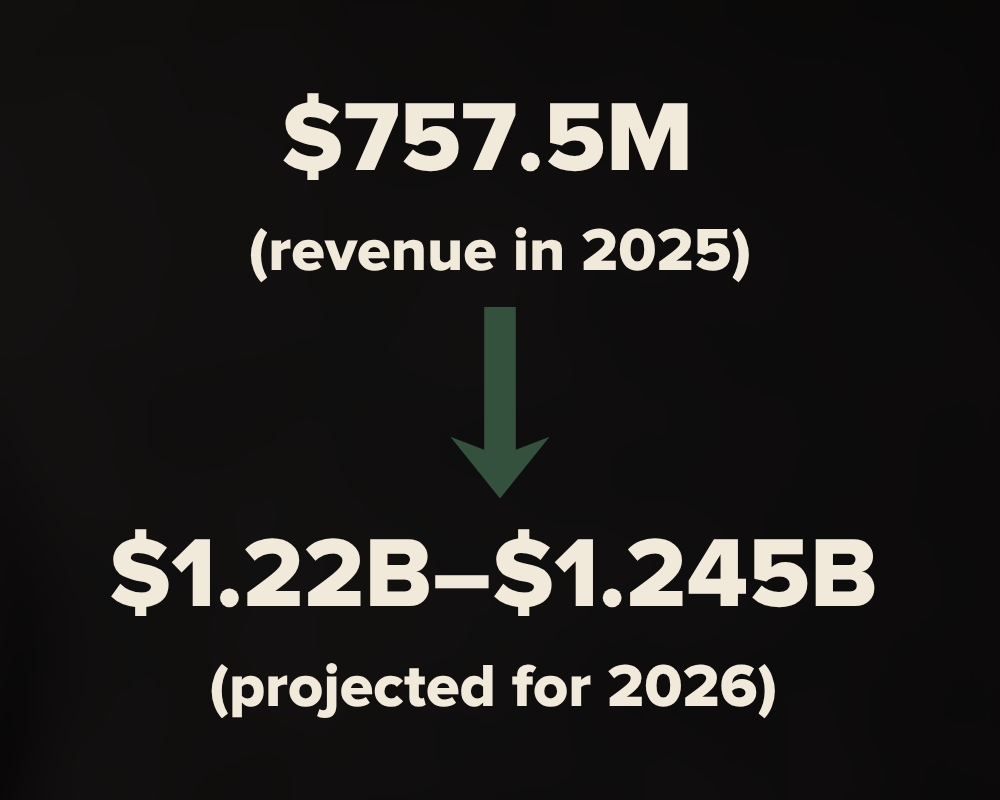
That's not exactly what you would expect to see when you hear "AI is killing online learning."
There's a catch, though.
That 2026 number includes revenue from Udemy, which Coursera acquired in May. So the story isn't simply that Coursera suddenly grew by 60%.
In fact, Coursera's Q2 revenue was up 60% year over year on a reported basis, but declined 1% on a normalized basis.
The more interesting question is how Coursera is adapting in the age of AI.
Because AI didn't just make learning cheaper, it also created a whole new set of things people need to learn.
How to use AI.
How to work alongside AI.
How to prove you have AI skills.
And most importantly, how to keep your skills relevant as technology evolves.
Coursera seems to have figured this out.
Instead of trying to compete with ChatGPT on things like who can explain something better, Coursera is building a business around skills, professional credentials, enterprise training, and AI-powered learning.
And this strategy is starting to show up in its product, subscriber growth, enterprise business, and demand for its generative AI courses.
AI Didn't Kill Learning, It Amplified It
On the contrary, it made people want to learn more.
Keeping yourself up to date with the latest advancements in AI is becoming less of a nice-to-have and more of a necessity for anyone trying to keep their job.
And the demand is showing up.
Coursera and Udemy now offer nearly 10,000 GenAI courses, and learners are enrolling in these courses at a rate of more than 45 enrollments per minute (up from 25 per minute in 2025)
People aren't just learning about AI.
They are learning how to use it, build stuff with it, apply it to their jobs, automate tasks, and, most importantly, prove they actually have these skills.
Here are the popular AI credentials.
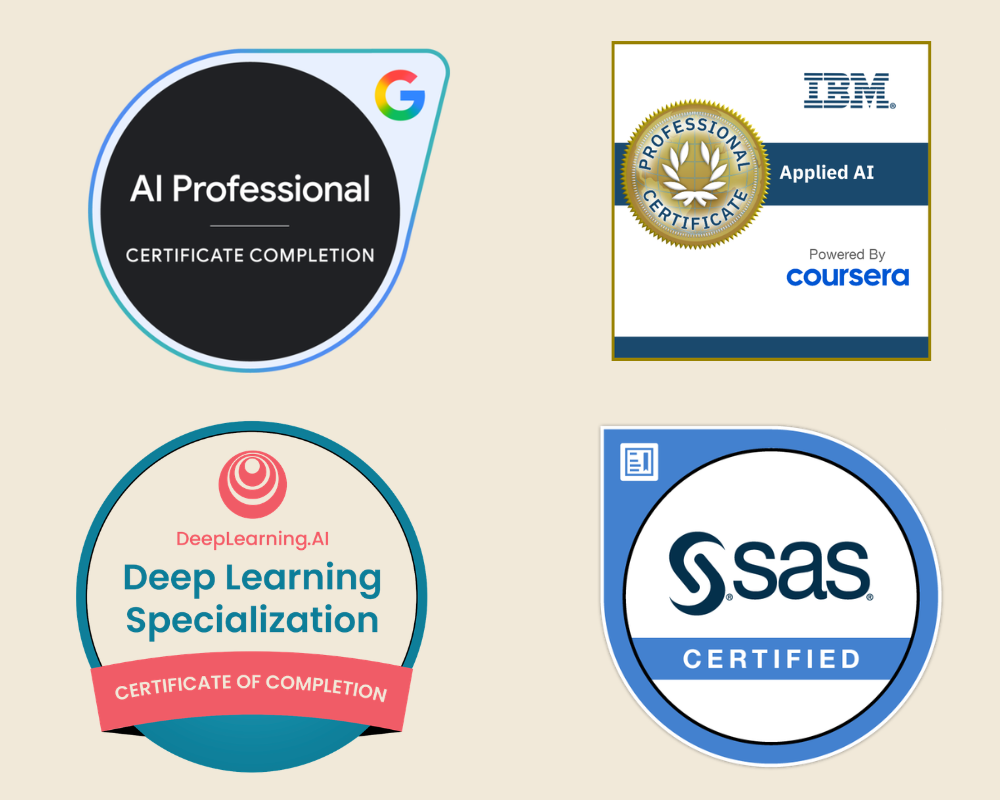
So what's Coursera doing?
They are making AI a part of the learning experience itself.
Its platform already includes AI-powered features such as personalized guidance, role-play, and Course Builder, while its Skills Tracks connect your learning to your specific occupation and requirements.
And it's betting even bigger on AI.
In July 2026, Coursera invested $100 million in LearnVector, an AI-native learning company founded by Andrew Ng, to develop more personalized, one-to-one learning experiences powered by AI agents.
Coursera isn't just becoming a medium for learning about AI.
It's integrating AI into how it teaches.
Coursera Started Selling Skills
We see, there was a time not too long ago when online learning was basically:
"Here's a bunch of courses. Figure out what to do with them."
Coursera is moving away from that and is organizing learning around one simple question:
"What skills do you actually need for the job you want?"
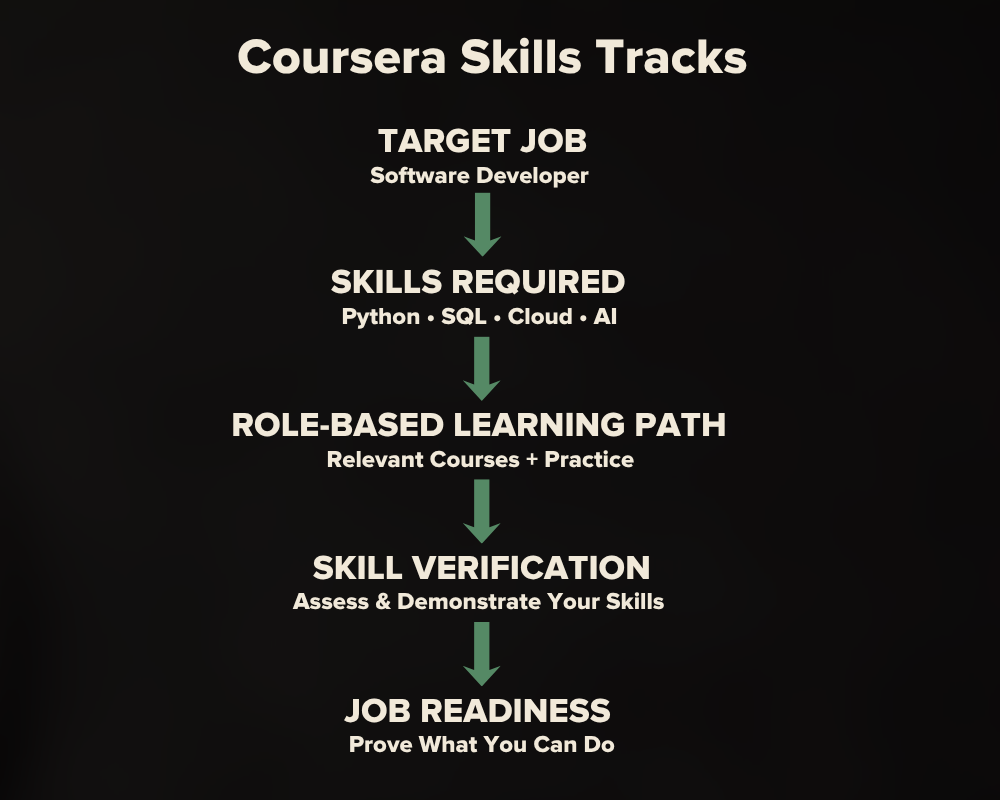
Enter Skills Tracks.
Coursera launched Skills Tracks for specific occupations, using its Career Graph and labor-market data to connect jobs with their required skill set.
Instead of randomly picking courses from thousands of options, learners can follow a path built around the skills a particular role actually requires.
And then there are the credentials.
Coursera now offers Professional Certificates and other credentials from major companies and institutions, including Google, Microsoft, Meta, and Google DeepMind.
Its 2026 micro-credential report also says enrollments in these credentials grew nearly 50% over the last year.
The marketing angle here is also something you need to understand.
A course is something you complete to gain knowledge.
A credential gives you the knowledge and something to show to an employer.
And that fact makes the value of the learning easier to communicate.
Coursera already has the scale to make this model work, with 197 million registered learners and 375+ university and industry partners as of the end of 2025.
Coursera isn't just selling courses now.
It's selling a path that takes you from learning to proving you actually have the skills.
Why Enterprise Learning is Important
Individual learners are great, but companies are where things get really interesting.
If you really want to build a recurring business around online learning, selling to companies is a pretty good place to start.
Think about the difference in scale.
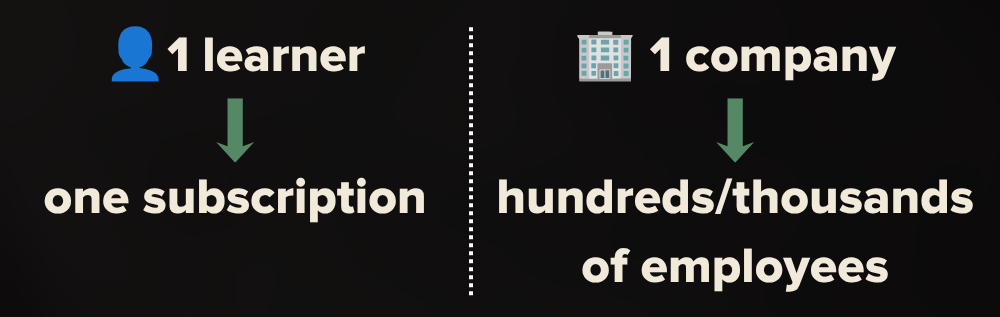
One person buying a Coursera subscription is one customer.
A company, on the other hand, can buy learning for hundreds or even thousands of employees.
And that's precisely why Coursera has been leaning heavily into enterprise learning.
In Q2 2026, Coursera's enterprise learning division generated $140 million in revenue, up 118% from the previous year on a reported basis (on a normalized basis, enterprise revenue grew by 3%).
The combined Coursera-Udemy business also had 12,107 enterprise customers, with a 91% net revenue retention rate.
That last number is worth looking at.
A 91% net revenue retention rate means revenue from the existing customer base declined overall after accounting for expansion, contraction, and attrition.
So while companies remain an important part of Coursera's business, there's still room for the enterprise segment to improve retention.
And this is where Coursera's shift toward skills becomes even more important.
Companies don't really care whether their employees completed a random 12-hour course.
They care whether their employees can actually do something useful afterward.
That's why Coursera is moving toward skills, credentials, and workforce development rather than simply selling access to a library of courses.
And the model is becoming increasingly recurring, too.
In the above-mentioned Q2 enterprise revenue of $140 million, $139.4 million came from subscriptions.
So while ChatGPT may be competing with Coursera for individual learners' attention, companies are paying Coursera to build the skills they need across their workforce.
And that's a completely different story.
Coursera Is Marketing Where People Already Learn
Here's where Coursera's marketing strategy gets really interesting.
For years, the playbook was fairly straightforward:
Someone searches "Best AI Course" on Google, finds something on Coursera, and signs up to access it.
But now that more people are using AI to ask questions instead of searching for everything themselves, Coursera needs to show up in those conversations too.
And it seems to be doing just that.
In 2025, Coursera partnered with OpenAI to become one of the first apps in ChatGPT, letting users discover Coursera content directly in AI conversations. At the time, ChatGPT had 800 million+ weekly users.
They didn't stop there.
Coursera has since launched a learning agent in Microsoft Copilot and introduced a connector for Claude, putting its learning content directly into the tools people already use to work and learn.
There is a catch, however: these integrations aren't distribution channels open for everyone.
The Copilot learning agent is currently available to organizations with enterprise licenses for both Coursera and Microsoft 365 Copilot, while the Claude connector is designed for enterprise learners accessing content from their organization's Coursera catalog.
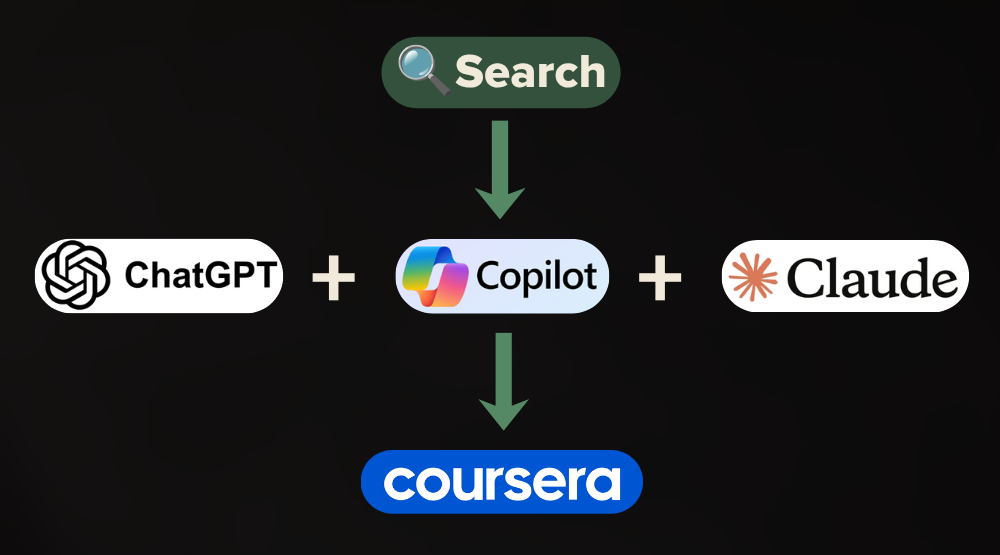
Think about what that means for marketing.
Now, Coursera no longer has to wait for someone to search for a course. It can also show up when someone is already trying to learn something.
They could reach people asking ChatGPT how to build an AI workflow, someone asking Claude how to improve their data skills, or someone asking Copilot for help while using Excel.
They are no longer relying only on Google to reach learners.
They are optimizing for everywhere that learning happens.
And as AI changes how people discover information, it's a pretty important place to be.
The AI Era Changed What Coursera Is Selling
So, did AI kill Coursera?
Not exactly.
If anything, AI has forced Coursera to rethink what it's actually selling.
It's no longer just about having thousands of courses sitting on a platform.
Coursera is building around AI-powered learning, skills-based paths through Skills Tracks, professional credentials, enterprise training, and distribution by showing up in conversations across AI platforms where people are actually learning.
It's true that AI has made learning cheaper.
You could ask ChatGPT to explain almost anything, generate a study plan, or even teach you a new skill.
But knowing something and proving you know it are two very different things.
That's where Coursera is trying to position itself.
It's trying to become the layer between “I want to learn this” and “I can actually prove I know how to do this.”
And in a world where AI is making information easier to access every day, that could become one of the most valuable things Coursera sells.